
News

A Richmond resident has filed a ballot initiative that would require the city to dedicate up to half of its locally generated revenue to public safety and maintain a minimum of 187 sworn police officers, a base that sits 40 officers above where the department stands today.
Michael Taylor Caine, a Richmond resident, submitted the petition to the City Clerk's office Friday, triggering a process that requires the City Attorney to prepare an official ballot title and summary. If enough signatures are gathered to qualify it, the measure would go before Richmond voters.
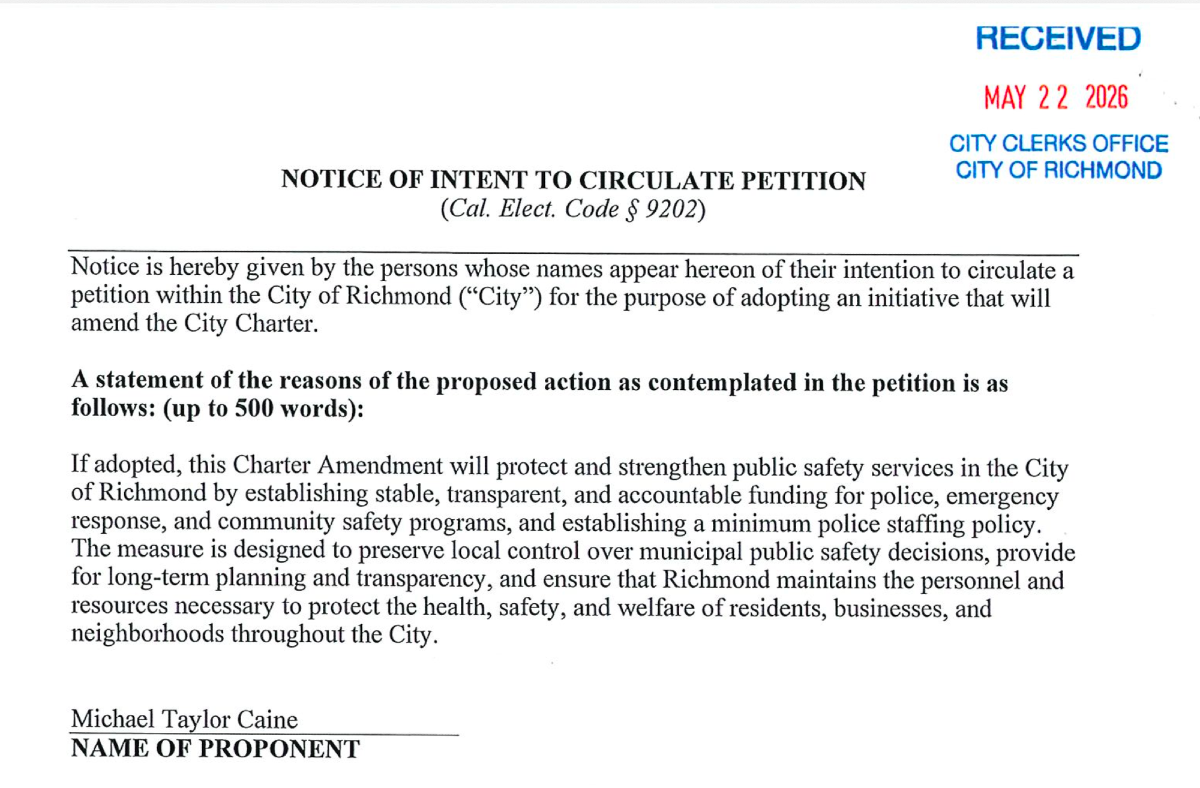
The initiative, called the "Richmond Public Safety Funding and Minimum Staffing Charter Amendment," would embed two new articles directly into the city's charter, making them harder to undo than ordinary city ordinances.
The filing comes as Police Chief Timothy Simmons has been publicly describing a department struggling to meet basic operational demands with the staff it has.
Presenting to the City Council on May 5, Simmons said the department is fielding roughly 92,000 calls for service each year, about 252 per day, while carrying 18 sworn vacancies out of 147 authorized positions. Nine officers are still completing academy training and are not yet on the street.
Simmons also disclosed that 40 percent of the patrol bureau is still in its probationary period, meaning nearly half the patrol force is new enough to require intensive oversight from senior officers. "It's high supervision right now," he said.
The issue of police staffing has been documented by two studies commissioned by the city of Richmond. A 2023 report by Matrix Consulting Group called Richmond's police staffing levels "seriously deficient" and recommended adding 40 officers to reach 185. A 2024 workforce analysis by Raftelis Financial Consultants recommended adding a dozen more sworn officers as part of a broader citywide staffing increase.
Report: Richmond Police staffing levels ‘seriously deficient’ to meet the needs of the public
A report on public safety staffing requested by the Richmond City Council has called the current police staffing levels ‘seriously deficient’ to meet the needs of the public and said officer turnover at the Richmond Police Department was an “unsustainable crisis.” The report by Matrix Consulting Group created a data
 Soren Hemmila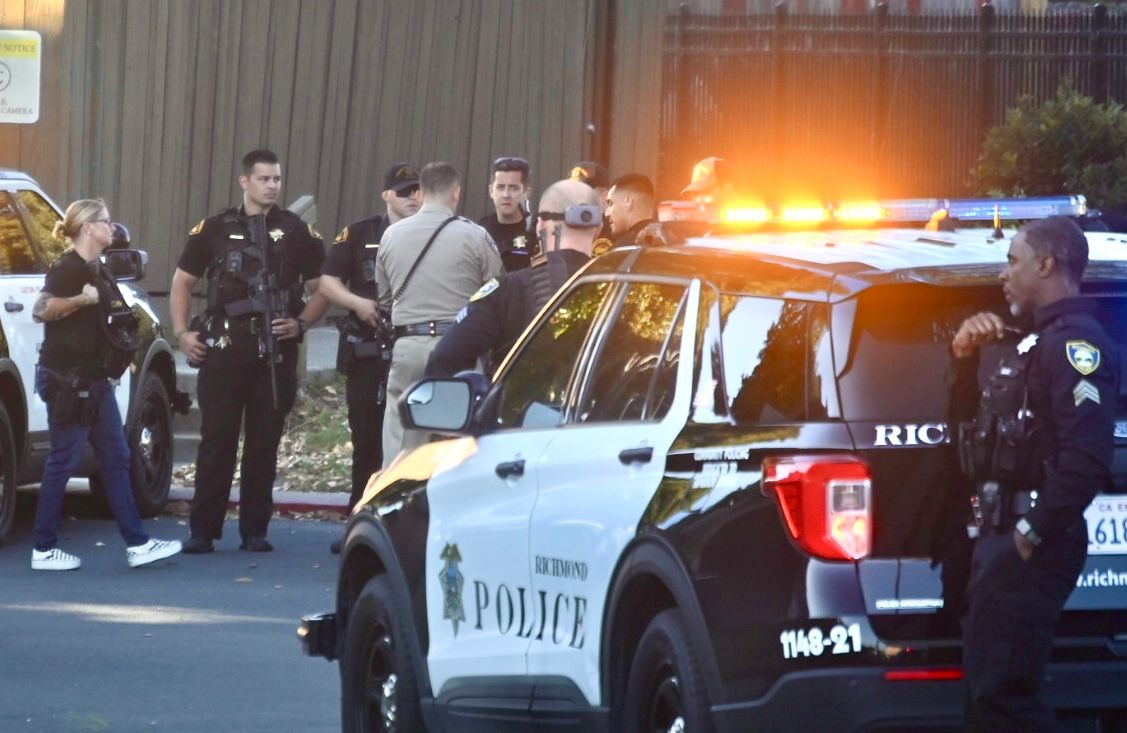
Under the initiative, the city would be required to create a dedicated "Public Safety Fund" and funnel a growing share of locally generated unrestricted revenue into it: 25 percent in the first year after adoption, 40 percent in the second, and 50 percent from the third year onward.
Those funds could only be spent on public safety purposes as defined in the measure, including police services, emergency medical response and paramedics, emergency preparedness, and violence prevention and community safety programs. The council would retain authority to decide how the money is distributed among those categories.
The second article would require the city to budget for and make best efforts to maintain at least 187 full-time sworn police officers, beginning in the second fiscal year after voter approval. The measure acknowledges that vacancies caused by retirements, resignations, disability leave, or hiring shortfalls would not constitute a violation as long as the city is making good-faith efforts to comply.
City budget documents show Richmond's general fund for FY2025-26 is budgeted at roughly $306 million in total revenues, but much of that includes one-time funds, state money, grants, and transfers that the measure would exclude from its calculation. The locally generated unrestricted revenue base is estimated at roughly $200 million, built primarily from property taxes, sales and use tax, and the utility users tax. At full implementation in year three, fifty percent of that estimated sum, roughly $100 million, would flow into the Public Safety Fund.
Backers of the measure say that figure overstates what it would actually require. The term "Locally Generated Unrestricted Revenues" is narrowly defined in the measure, and allocations occur only after the city has met all its legal obligations. The city, not the initiative's backers, would calculate the actual number.
Caine, a Richmond resident, filed the petition. In his cover letter to the City Clerk, Caine appointed the attorneys of the Kaufman Legal Group, a Los Angeles-based firm, as his representatives, naming George M. Yin, Elizabeth Harte, Haley Rosenspire, and Robert Farewell.
He also appointed Ben Therriault and his designee. Therriault is the president of the Richmond Police Officers Association, the union representing rank-and-file officers, and has been one of the most vocal critics of the city's handling of police staffing. In a press release issued Friday, the RPOA said it supports the measure.
"For more than five years, every independent study commissioned by the city has reached the same conclusion: Richmond is dangerously understaffed," Therriault said. "The council has the studies. The community has the data. What's been missing is a stable framework. This measure gives Richmond voters the chance to put one in place."
On the agenda: Richmond facing staffing challenges, needs dozens of new employees, says report
A workforce analysis by Raftelis Financial Consultants to be presented at the May 28 Richmond City Council meeting recommends filling vacancies and adding 74 new positions, including a dozen more police officers, to meet current service level expectations for all of the city’s existing programs and services for $12.
Soren Hemmila
The filing is not the first time the RPOA has used the citizen initiative process to reshape Richmond's city charter. The union was a major financial backer of Measure J, the Richmond Election Reform Act, which voters approved in November 2024 by nearly 58 percent. That measure, also placed on the ballot through a petition drive, changed how Richmond elects its mayor and city councilmembers by introducing a top-two primary system.
The measure includes provisions designed to protect the city from being legally cornered.
On the funding side, the required allocation kicks in only after the city has covered all legally required expenditures, including debt service, pension obligations, and collectively bargained contracts. The City Council can also declare a fiscal emergency by a two-thirds vote to temporarily reduce or suspend the funding requirement; however, any suspension would expire after one fiscal year unless renewed.
The staffing mandate can be suspended with a four-fifths council vote, findings of a severe fiscal emergency or catastrophic circumstances, and evidence that the city has exhausted reasonable alternatives.
Neither provision, the measure states, can be used to require the deployment of officers in any specific manner or to limit the police chief's operational discretion.
Under the California Elections Code, the City Attorney must now prepare an official ballot title and summary. Caine would then need to gather a sufficient number of valid signatures from registered Richmond voters to qualify the measure for the ballot.
YOU GET MORE WITH A PAID SUBSCRIPTION
Your subscription enables Grandview Independent to deliver more:
- More time devoted to in-depth reporting
- Longer, more comprehensive stories
- Greater coverage of what matters to our community
Quality journalism costs money. Subscriptions allow us to keep reporting the stories that matter, without paywalls getting in the way of critical community information.
CLICK HERE TO SUBSCRIBE - Starting at just $10/month
FOLLOW US FOR BREAKING NEWS:
• Twitter: @GrandviewIndy
• Instagram: @GrandviewIndependent
• Facebook: @Grandview Independent
Copyright © 2026 Grandview Independent, all rights reserved.
Members Discussion