
City Council Updates
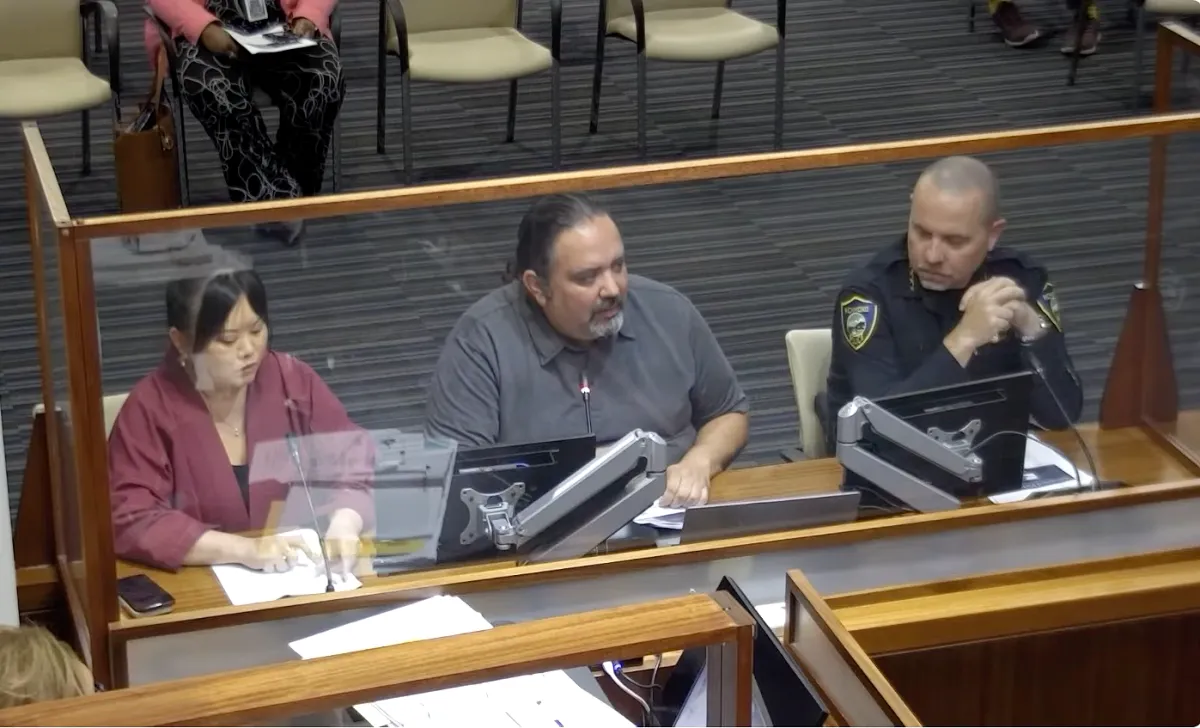
The Richmond City Council heard a detailed accounting Tuesday night of what the city is doing and what it refuses to do to shield immigrant residents from federal enforcement, as the police chief described turning away a federal request for help and committed to investigating crimes committed by ICE agents within city limits.
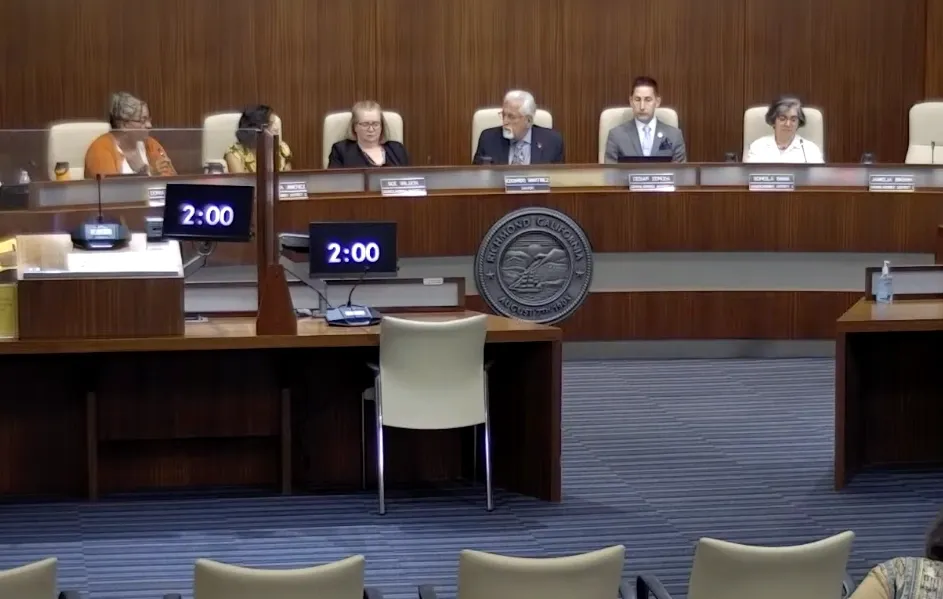
The council item was the latest in a series of discussions the council directed city staff to lead. It ended with Mayor Eduardo Martinez announcing a three-member ad hoc committee consisting of himself, Vice Mayor Doria Robinson, and Councilmember Claudia Jimenez to steer the work alongside staff as the implementation plan continues to develop.
On the agenda: Iran resolution, immigration report, Cheese Park, and a renamed holiday
The Richmond City Council will take up a packed agenda Tuesday night, including a proposal to rename the city’s Cesar Chavez Day holiday, a resolution opposing U.S. military action against Iran, and a long-delayed briefing on efforts to shield residents from federal immigration enforcement. A holiday gets a
 Soren Hemmila
Police chief's message to Homeland Security: No
Chief Tim Simmons told the council his department had already faced a real test of its sanctuary commitments.
"We've had one request by the Department of Homeland Security to provide a perimeter for them, which was emphatically denied," Simmons said. "We will not participate. It was a flat-out no, and that was the end of that."
The remarks came after Councilmember Jimenez raised an incident at San Francisco International Airport that has been circulating in local immigrant advocacy circles. Video showed San Francisco police forming a protective ring around ICE agents, a move Jimenez said legal advocates are calling a violation of that city's sanctuary policy. Jimenez wanted to know if something similar could happen here.
Simmons said it would not. "We would not protect ICE to do their job in any way, shape, or form," he said. "Our main priority is going to be how to protect First Amendment rights of our residents, how to protect our residents' properties, and how to protect our residents' lives. Not how to make way for federal enforcement to do their jobs."
Richmond Police Department Policy 414, which Simmons noted is publicly available on the department's transparency portal, contains a series of firm prohibitions. Officers are barred from conducting immigration sweeps, from honoring ICE detainers, from inquiring about immigration status for enforcement purposes, and from providing any support services to federal immigration agents, including traffic control or perimeter assistance. Simmons said violations of those prohibitions are a disciplinary matter.
If ICE breaks the law
Vice Mayor Robinson raised a question she said has come up repeatedly in community meetings around Richmond: what happens if federal agents commit crimes while conducting enforcement operations here?
Robinson pointed to a case in Minnesota where local police found themselves in a difficult position after a homicide involving federal agents, and asked whether Richmond's protocols address whether the department would investigate potential crimes by ICE.
Simmons said the answer is yes.
"Any officer-involved shooting that occurs in the city of Richmond that does not involve a Richmond employee, we would be the host investigating agency," he said. Simmons added that the Contra Costa County Sheriff's Office would conduct a parallel investigation under the county's law enforcement involved fatal incident protocol.
Robinson pressed on less lethal situations, describing scenes she said residents have been watching on news coverage from other parts of the country: car windows smashed, people claiming U.S. citizenship being dragged away.
Simmons said those cases would go through the standard process. "If we had a resident in Richmond that wanted to file a criminal complaint for any reason, we would investigate that complaint and present it to the district attorney's office the way we would investigate anybody in our community that believes they were victimized by a crime, regardless of who it is," he said.
The question of real-time intervention drew a more careful response. Simmons acknowledged that state law and department policy create a narrow path for federal agents when they are actively conducting an enforcement operation.
"State law and our policy is very explicit about interceding," he said. "We can't prohibit or intercede, and we cannot allow and protect. We have to maintain a sort of neutral ground if they're engaged in some sort of enforcement action."
City Attorney Shannon Moore added a blunt warning about the stakes of crossing that line.
"We do know of examples where the federal government has chosen to prosecute local officials for their interference," Moore said. "We will not assist them, but we will not interfere with their immigration efforts."
600-person network already operating in Richmond
Jimenez drew attention to something already happening on the ground in Richmond: a community rapid-response network, she said, has grown to more than 600 volunteers organized to support families facing immigration enforcement.
"There is a rapid response with over 600 residents," Jimenez said. "It's a group where people are ready, volunteer residents, who are ready to support any family in need."
Simmons confirmed that his department has been in contact with leaders from that network, noting a Saturday meeting at the Latina Center with 24 community leaders.
"We offered to help resource them through our Crime Prevention Unit," Simmons said, describing plans to train the volunteers, supply them with contact lists, and connect them to organizations like Catholic Charities. "Here's the number for Catholic Charities. Let's put it in your cell phone now."
The ordinance timeline
Senior Assistant City Attorney Kimberly Chin walked the council through the history of Richmond's sanctuary framework, tracing it from a 1990 ordinance through the most recent 2025 measure that added explicit restrictions on the use of city resources for federal immigration enforcement.
A new round of strengthening amendments to that ordinance is on track for a first reading on April 7 and a second reading on April 21, taking effect 30 days later.
The council also heard from project manager Gabino Arredondo about the "Safeguard Richmond Coordinated Response Plan," a citywide framework intended to coordinate city departments, legal service providers, schools, neighborhood councils, and community clinics when enforcement actions occur. The city is also evaluating communication platforms to build a multilingual notification system.
Three organizations are currently funded under the city's Immigrant Legal Services and Public Awareness Campaign: the Multicultural Institute on Macdonald Avenue, Catholic Charities East Bay on Harbour Way, and East Bay Sanctuary Covenant, which specializes in removal defense. Arredondo said the services are available to Richmond residents regardless of income.
YOU GET MORE WITH A PAID SUBSCRIPTION
Your subscription enables Grandview Independent to deliver more:
- More time devoted to in-depth reporting
- Longer, more comprehensive stories
- Greater coverage of what matters to our community
Quality journalism costs money. Subscriptions allow us to keep reporting the stories that matter, without paywalls getting in the way of critical community information.
CLICK HERE TO SUBSCRIBE - Starting at just $10/month
FOLLOW US FOR BREAKING NEWS:
• Twitter: @GrandviewIndy
• Instagram: @GrandviewIndependent
• Facebook: @Grandview Independent
Copyright © 2026 Grandview Independent, all rights reserved.
Members Discussion