
Election'26
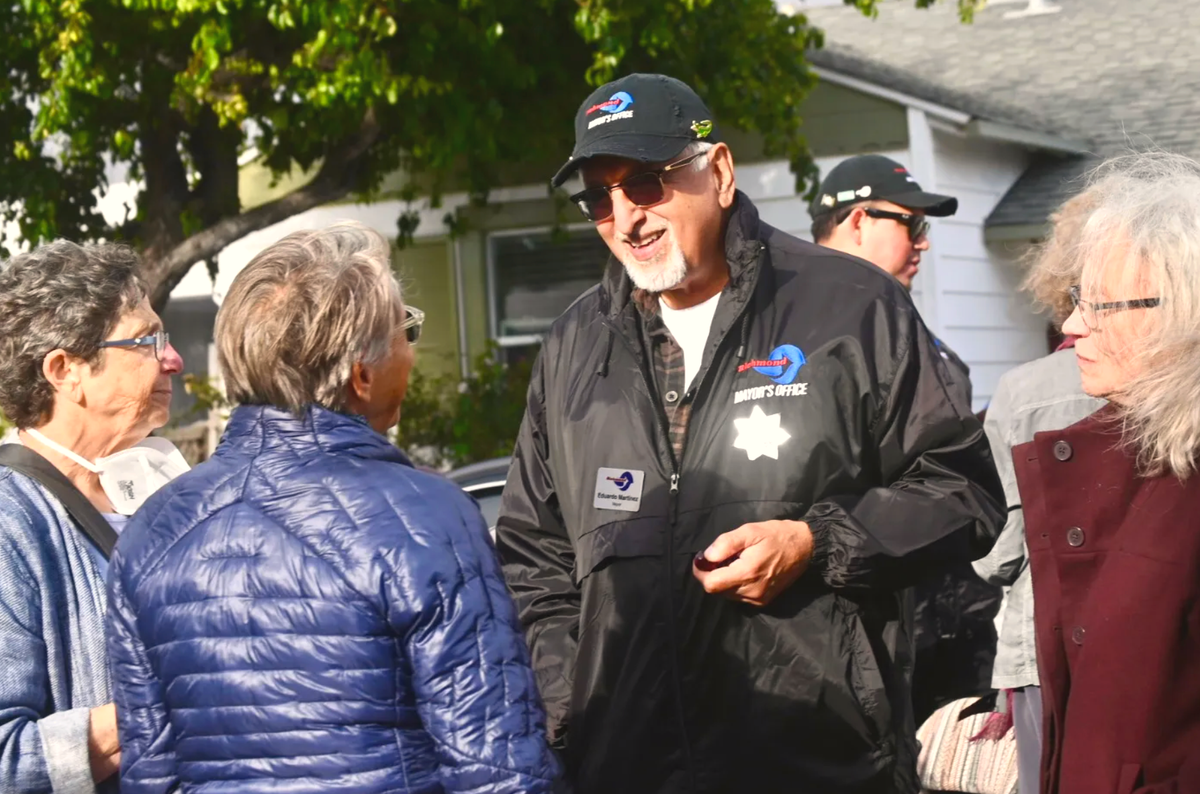
Eduardo Martinez did not set out to be a politician.
A retired elementary school teacher who had also taught at juvenile hall, years earlier, he marched from Downer Elementary School to Sacramento to demand relief from a debt the state had saddled the district with. The Richmond Progressive Alliance had supported that effort and knew who he was.
“They had endorsed and marched with us when we went to Sacramento,” Martinez said, “so they knew who I was and what my values were.”
Martinez was contemplating a run for the school board when Juan Reardon called and suggested he run for Richmond City Council instead. He did. He spent eight years on the council and is now finishing his first term as mayor. He is seeking four more years.
This time, he does not have the RPA’s endorsement.
The split
Martinez is careful about how he describes what happened between him and the organization that brought him into local politics. Asked directly about his current relationship with the RPA, he paused for a long time.
“I want to say the same,” he said, “but it is, and it isn’t.”
Asked to explain what led to the split, he said, “It’s all in the magic of the JCRC,” and left it there.
The JCRC, or Jewish Community Relations Council, called for Martinez’s resignation after he shared posts on LinkedIn. Martinez issued apologies and said the posts reflected his personal opinions, not those of his office.
He offers one more layer of explanation. Martinez says people who hear him speak often do not have the same context he has. Without that context, his comments get misunderstood.
“They fill it in with their own experience, their own values, and generally twist my comments into something that it wasn’t meant to be,” he said. “Better for me not to comment.”
He is running anyway.

Who he is
Martinez was born in Texas. He ended up in California the way many people did: following someone else. A woman he knew in El Cerrito called him, flew out to him, and persuaded him to come back with her.
He arrived looking for work, cut glass for a time, made cabinets, and worked as an orderly at the county hospital in Martinez. He found the hospital work emotionally difficult.
He recalled one moment that has stayed with him.
“He got well, got out. The next time I saw him, it was in the emergency room, and he came in with heart failure, and we couldn’t revive him, and he passed in front of me,” Martinez said. “That really, really tore me up.”
For a time in the early 1970s, he lived on a commune in El Cerrito, pooling money with others, holding weekly meetings, and eventually buying 113 acres of farmland in Arkansas as part of the back-to-the-land movement. He moved there and farmed. His girlfriend was at UC Berkeley, and wages in Arkansas were lower than in California, so he moved back to send money to the farm.
“Life swallows you up,” he said. “Things that are far away start to fade. Things that are more immediate become more concrete.”
He eventually became a teacher, working in elementary schools and in seventh- and eighth-grade self-contained classrooms at the Juvenile Court School, helping students who had been expelled or were in juvenile hall transition back into regular school.
Those years of teaching, organizing, and navigating hardship gave Martinez a perspective on Richmond's challenges. Housing is where he puts that perspective to work.
On housing
Martinez points to a cluster of completed projects as evidence of progress: renovated buildings at Barrett and Marina Way, the refurbished and expanded Nevin Terrace housing, and a new development in North Richmond that recently held its ribbon-cutting.
He also acknowledges that homelessness continues and that the city’s resources are limited. He speaks about it with some personal weight. He was homeless himself at one point. In 1977, he walked into an art gallery and met the woman who would become his wife. She saw something in him, he said, that nobody else did at the time.
Having experienced homelessness himself, he knows its toll firsthand.
“I know how it wears on your confidence, on your self-esteem,” Martinez said. “You start to feel like you’re not part of things anymore.”
Wraparound services built into projects like Richmond’s Homekey-funded Motel 6 conversion are what make the cost worthwhile, he said, arguing that the benefits justify the expense. Housing someone is only the first step; long-term recovery depends on the support services that come with it.
Martinez wants to digitize the entire planning department to speed up housing approvals. The city has already partnered with the Bloomberg Foundation on a data management program, including efforts to break down silos between departments so information can flow more easily.
He also wants to revive a vacancy tax that he and former Mayor Tom Butt previously attempted to pass. Absentee landlords sitting on empty lots, he said, are a problem that requires a financial incentive to solve.
“Any property that’s not being used for housing or commerce would be taxed,” he said. Parks would be exempt, but empty lots that could support housing would not.
His vision for housing runs through downtown, along Macdonald Avenue, following a model common in Berkeley: businesses on the ground floor, apartments above. He calls the concept “neighborhood community nodes,” designated areas across the city where small shops, barbershops and cafes could cluster within walking distance, each neighborhood developing its own character.
Currently, Martinez lives in the Richmond Annex and said his area illustrates the idea. Within a few blocks are El Cerrito Natural Grocery, a 24 Hour Fitness, Down Home Music Store, a bank, a tailor, and cleaners, all within walking distance.
On public safety
Martinez defines public safety more broadly than policing. He describes part of it as “public comfort,” the ability to trust your environment and know your neighbors are watching out for each other.
He told a story about a man who showed up at his house with a machete and cut a cactus stalk out of his yard. A neighbor across the street came out onto her porch and confronted him loudly enough that he left.
“She felt safe enough to do that,” Martinez said.
He supports ROCK, the city’s response program for non-medical, non-violent and behavioral health calls. He described a case involving a late-night dispute over loud music that had repeatedly drawn police without resolution. ROCK intervened.
One neighbor spoke Spanish, the other English. Staff brought interpretation headphones and worked with both parties, testing different volumes until they reached a level both could accept.
“That took an issue away from police so that the police could attend to things which are more dire and require real resources,” Martinez said.
He does not support cutting the public safety budget. He wants to expand both traditional policing and alternative response programs. He said he has told the police chief that once the department reaches its current hiring capacity, it should return to the council if more officers are needed.
He also wants the fire department to expand its medical emergency capabilities as part of a broader approach to public safety.
On fiscal priorities
When an organization came to him asking for $30 million from what it described as “Chevron funds,” Martinez said he pushed back.
First, he told them the money should be described as general funds, not a separate pot. Second, he said that if they were seeking $30 million, they needed to first consult with the broader coalition involved in placing the Chevron-related measure on the ballot.
He was also critical of councilmembers who promised public input on spending decisions but then discussed using the funds to pay down pension obligations without broader community engagement.
Asked how he would use a large infusion of general funds, Martinez said he is inclined to preserve the principal and spend the interest.
“It’s a continual money generator, as opposed to just spending it now and then not having any money to show for it,” he said.
He also pointed to the proposed East Bay Public Bank, a regional effort involving Alameda County, Oakland, and Richmond. By placing public funds in such an institution, he said, interest could remain local rather than flowing to large financial institutions, while also allowing the city to borrow from its own bank.
On the next four years
Martinez’s top priority is development at Hilltop and downtown, two areas he said have stalled. He was particularly critical of Prologis, the developer that owns the Hilltop site, citing a lack of progress.
He envisions connecting the lake to Hilltop and building out a community hub that integrates recreation. He also wants to see regular downtown events, similar to Oakland’s Friday night gatherings, bringing together art, entertainment, and food.
He supports revitalizing the port, moving the Red Oak Victory ship closer to Rosie the Riveter/World War II Home Front National Historical Park, and strengthening the connection between downtown and the ferry terminal.
He also wants the Craneway Pavilion to become a more active public space, with better promotion, so residents are aware of events.
He said the city’s civic plaza should function as a public space rather than a revenue-generating rental venue. He pointed to a Tibetan community group that had hoped to hold regular dance performances and lessons there but could not afford the fees.
“To charge for the use of the plaza inhibits the plaza as a community space,” he said.
Martinez has spent more than a decade in Richmond politics, first on the council and now as mayor. He is asking voters to evaluate his record and decide whether to give him another term.
“We’ve accomplished so much in the time that I’ve been mayor,” he said. “I would like to continue and advance some of the things that I’ve started.”
Grandview Independent will publish interviews with all candidates running for Richmond City Council and mayor in the coming weeks.
YOU GET MORE WITH A PAID SUBSCRIPTION
Your subscription enables Grandview Independent to deliver more:
- More time devoted to in-depth reporting
- Longer, more comprehensive stories
- Greater coverage of what matters to our community
Quality journalism costs money. Subscriptions allow us to keep reporting the stories that matter, without paywalls getting in the way of critical community information.
CLICK HERE TO SUBSCRIBE - Starting at just $10/month
FOLLOW US FOR BREAKING NEWS:
• Twitter: @GrandviewIndy
• Instagram: @GrandviewIndependent
• Facebook: @Grandview Independent
Copyright © 2026 Grandview Independent, all rights reserved.
Members Discussion