
Election'26
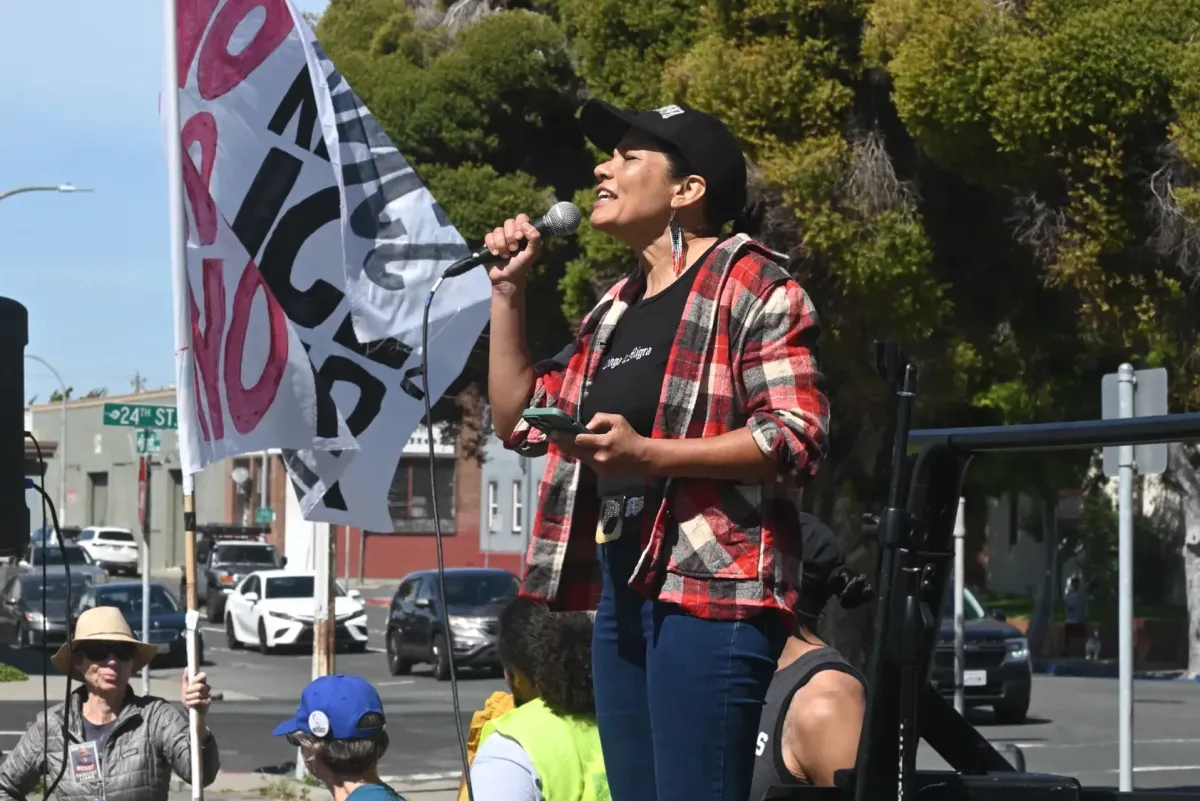
Claudia Jimenez arrived in the United States in 2007 without speaking a word of English, enrolled in ESL classes in Berkeley, passed a language proficiency exam, and gained admission to UC Berkeley's College of Environmental Design. By then, she had already spent a decade in the mountains of southwestern Colombia building houses with displaced farming families and promoting candidates for city council in a region where armed groups were crossing the ridges.
That biography is the frame through which Jimenez explains everything else: why she went into organizing, why she joined the Richmond City Council in 2021, and why she is now running for mayor.
"I am an immigrant," she said. "I have experience working in low-income communities in Colombia, and I brought that experience here. A lot of the immigrant community can come here with a lot of expertise, and they are not able to put that expertise into the world because the workforce is not providing those opportunities for them."
Before Richmond
Jimenez was trained as an architect in Cali, Colombia, and went to work for a nonprofit focused on affordable housing using ecological building materials. In 1999, a flood in the Andes displaced hundreds of families in a small community outside the city. The effort that followed secured international funding matched by the Spanish national government and produced 50 houses for 50 families, each with three bedrooms, built from local materials, accompanied by 2.5 hectares of farmland organized into a cooperative. Families contributed 250 hours of labor rather than cash.
"It was not only a project of building houses, but an economic project, because we believe, and the community believed, that farmers without lands are not farmers," she said. "Some older people who couldn't build their houses were doing other things. Women were cooking for everybody. And we were living there."
She stayed in the region for a decade, working with farming communities and indigenous groups in an area she describes as a red zone crossed by both the FARC and paramilitary forces. The team ran small farmers as candidates for the city council. She came to the United States in 2007 and earned a master's degree in landscape architecture and environmental planning from UC Berkeley in 2011, then took an organizing job that sent her to work in Richmond and Contra Costa County.
Much of that work centered on AB 109 prison realignment, which transferred responsibility for lower-level offenders to county jails and provided money to county agencies to reduce recidivism. Jimenez and allies at the Safe Return Project argued the money was flowing back into systems that had already failed.
"We said, if they need this support, why is all this money going to the same system that has been failing to accomplish the goal of reducing recidivism?" she said. "We made this campaign and were able to transfer $5.2 million from AB 109 to services in the community. Because of that, we created the Reentry Success Program, which is here on Macdonald. That was kind of the first step, people saying, this is what we need when we are coming home from incarceration."
In 2015, when Councilmember Tom Butt won the mayor's race and left a seat open, community members urged Jimenez to put her name forward for the appointment. She agreed, but with a limited vision for it.
"I said it will be two years, because I wanted to go back to Colombia, and have my kids live in Colombia," she said.
She was not selected and left for Colombia anyway, spending two years there before returning to Richmond. The experience of seeking the appointment stayed with her.
"Even though I wasn't appointed, I saw how much the community really supported me," she said. "I remember hundreds of people going there with my signs saying Claudia. That was really moving."
She ran again in November 2020 and was this time elected, taking office in January 2021.
Running for mayor
Jimenez is one of several candidates running for mayor this year. The current mayor, Eduardo Martinez, is seeking a second term. Both are affiliated with the Richmond Progressive Alliance, which endorsed Jimenez. Martinez has continued his campaign independently.
"Eduardo has the freedom to run. He just decided to run. That is unfortunate, because that is not what the progressive movement here has done before," she said. "But for us, residents and allied organizations have been asking me to step up because they think the moment needs stronger leadership. This is politics, and I have stronger leadership, and people think I can win."
On public safety
Jimenez describes public safety in explicitly holistic terms, which, for her, extend well beyond policing.
"Public safety for me is also streets being clean, parks being maintained, traffic calming, because that is safety for communities," she said. "For me, there are three major things: enforcement, education, and engineering solutions. Instead of us pretending and hoping that one department can serve all the needs in the community, we need a variety of services actually meeting and responding to the needs of the community."
She supports the Office of Neighborhood Safety, which she credits with helping reduce gun violence since 2007, and serves as the council liaison to the Community Crisis Response Program Advisory Board. This newly launched alternative response program handles calls that do not require armed officers. She said the program now has 11 staff members responding to calls. Jimenez said the program took two years longer than planned to launch because of a lawsuit filed by the Richmond Police Officers Association.
"We had the money two years ago, but we had the RPOA suing the city, and it took two years to resolve that," she said. "I am hoping that now we can start serving the community that right now is calling 911 and waiting a long time because it's not an emergency or dangerous situation, but it needs to be addressed."
Regarding police staffing, she argues that the more immediate problem is unfilled positions, which are driving overtime costs to unsustainable levels.
"Some police officers get paid with overtime over $400,000 or $500,000 a year," she said. "We had defunded the schools, defunded mental health, defunded health and jobs, and people had been left with all the problems of society to be resolved by just one department. We are overloading just one department instead of thinking about how we can address the needs in the community with the right kind of service."
On housing
Jimenez points to Hilltop and the Macdonald Avenue corridor as primary sites for new housing, and argues the pace of development has been constrained less by zoning than by financing and city capacity.
"The city has been letting the market tell us what can be done. I'm thinking that the developers are going to be the ones breaking the deal. I think it's not going to happen that way," she said. "We need to be proactive about what the financing mechanisms are. Can we shorten the permitting time? Because time is the essence."
She said she has spoken with the director of housing investment at the AFL-CIO about partnerships that would bring labor pension capital into affordable housing projects tied to project labor agreements. She described a goal of 20,000 new units over 10 years, which she called a dream rather than a formal plan, and identified the permitting process as a structural bottleneck.
"When I talk to developers, they say it takes so much time. Probably what is happening is that one staff member is looking at five projects, and it doesn't move because it's just one person," she said. "We need to really have a housing department or a housing division within community development. We need a better structure within the city that addresses housing, and we don't have it."
Chevron and economic transition
Jimenez says Richmond cannot afford to remain as dependent on Chevron as it currently is. The refinery accounts for roughly 24 percent of the city's budget.
"Being dependent, especially on the fossil fuel industry, makes us so vulnerable," she said. "Chevron has been here for generations, and I am not saying we should close them right now. It has to be a transition where we plan. But it will be irresponsible not to think about that. It's not financially savvy to be so dependent on just one type of business for 24 percent of the budget. If it closes tomorrow, we are devastated."
She pointed to Benicia, where Valero announced a closure and left the community without time to prepare, as a cautionary example. She sits on the Green Empowerment Zone, a state-recognized initiative working with the UC Berkeley Labor Center to identify green industries that could replace refinery employment, and pointed to offshore wind, battery manufacturing, and ferry electrification as possibilities tied to the port.
"The state created this Green Empowerment Zone because even they recognize we need to do this transition," she said. "We have a deep-water port that can manufacture some of the components for offshore wind, like the base or the cables. There is so much that can happen here. What we are doing right now is making an assessment, an inventory of all the industrial sites we have, and what we can offer. And hopefully after Trump, we have a Democratic president willing to really put money into this green transition, because the planet needs it."
On city finances
One of the things Jimenez is most proud of is helping to get Richmond out of what she described as a bad financial deal.
In 2005, the city had issued Pension Obligation Bonds to cover its mounting debt to CalPERS, the state retirement system for public employees, borrowing money to fund the gap between what it had saved and what it owed workers in future retirement benefits. To manage that debt, the city signed interest rate swap agreements that locked Richmond into high fixed interest payments and prevented it from refinancing when rates dropped. During the pandemic, when interest rates fell to near zero nationwide, Richmond was still paying rates above five percent. By the time Jimenez got to the council, Richmond faced a $21.992 million payment to Royal Bank of Canada set to trigger automatically in August 2023.
In 2022, the city renegotiated its debt, issuing $154 million in new bonds to pay off the termination fee and convert its obligations into a conventional fixed-rate loan that can be refinanced without penalty if interest rates fall.
The refinancing extended the life of the loan from 2034 to 2044 to better align debt payments with the city's dedicated pension tax revenue. The debt is repaid through a combination of a dedicated property tax levy and the city's general fund. Jimenez says the deal saves the city $98 million through 2034, though the extended term adds roughly $62 million in additional debt service over the life of the loan.
The city is also pursuing litigation against Royal Bank of Canada and former advisors, after a review found Richmond had been sold one of the five most complex swap transactions in the country.
"Little Richmond had one of the five most complicated transactions in the country. Not New York, not Los Angeles," Jimenez said. "Now we have a plain vanilla loan, and if interest rates go down, we can refinance without any penalties."
She connected the work to a broader conviction.
"The budget represents our values," she said. "If we don't have money, I can just tell you whatever, and nothing is going to happen. So money is really key for advancing the things that we want to see in the community."
Beyond work
Every other Sunday, Jimenez makes the drive to Oakland to go salsa dancing. She wishes she did not have to leave Richmond to do it.
"I love going salsa dancing. I try to go every other Sunday, and I wish we had more of that here in Richmond so I don't have to go to Oakland," she said.
Grandview Independent will publish interviews with all candidates running for Richmond City Council and mayor.
YOU GET MORE WITH A PAID SUBSCRIPTION
Your subscription enables Grandview Independent to deliver more:
- More time devoted to in-depth reporting
- Longer, more comprehensive stories
- Greater coverage of what matters to our community
Quality journalism costs money. Subscriptions allow us to keep reporting the stories that matter, without paywalls getting in the way of critical community information.
CLICK HERE TO SUBSCRIBE - Starting at just $10/month
FOLLOW US FOR BREAKING NEWS:
• Twitter: @GrandviewIndy
• Instagram: @GrandviewIndependent
• Facebook: @Grandview Independent
Copyright © 2026 Grandview Independent, all rights reserved.
Members Discussion