
Education

The West Contra Costa Unified School District is confronting a $127 million budget shortfall over the next three years, prompting officials to propose widespread staff reductions, program cuts affecting 400 positions and restructuring that could merge small middle schools and reconfigure K-8 campuses.
Superintendent Cheryl Cotton outlined the financial situation during a community listening session at Pinole Middle School and Korematsu Middle School this week, less than a month after the district ended a four-day teacher strike with a tentative contract agreement that includes salary increases and enhanced health benefits.
Both the United Teachers of Richmond and Teamsters Local Union 856 ratified their contracts in December, but the agreements significantly increased the district’s financial obligations.
West Contra Costa teachers end strike with tentative contract agreement
Teachers in the West Contra Costa Unified School District reached a tentative agreement with district officials early Wednesday morning featuring wage increases, fully paid family healthcare, and program enhancements, according to statements from both sides. The agreement was reached after a 12-hour bargaining session that stretched past 2 a.m.
 Soren Hemmila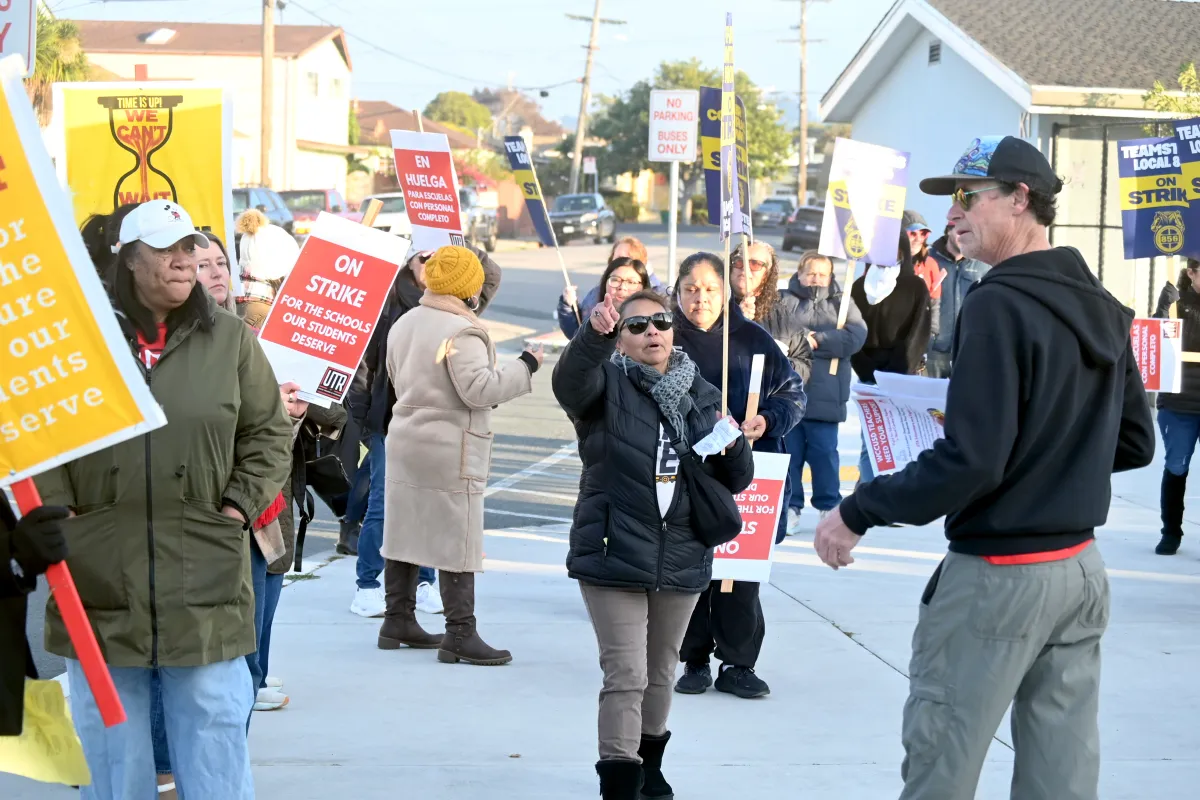
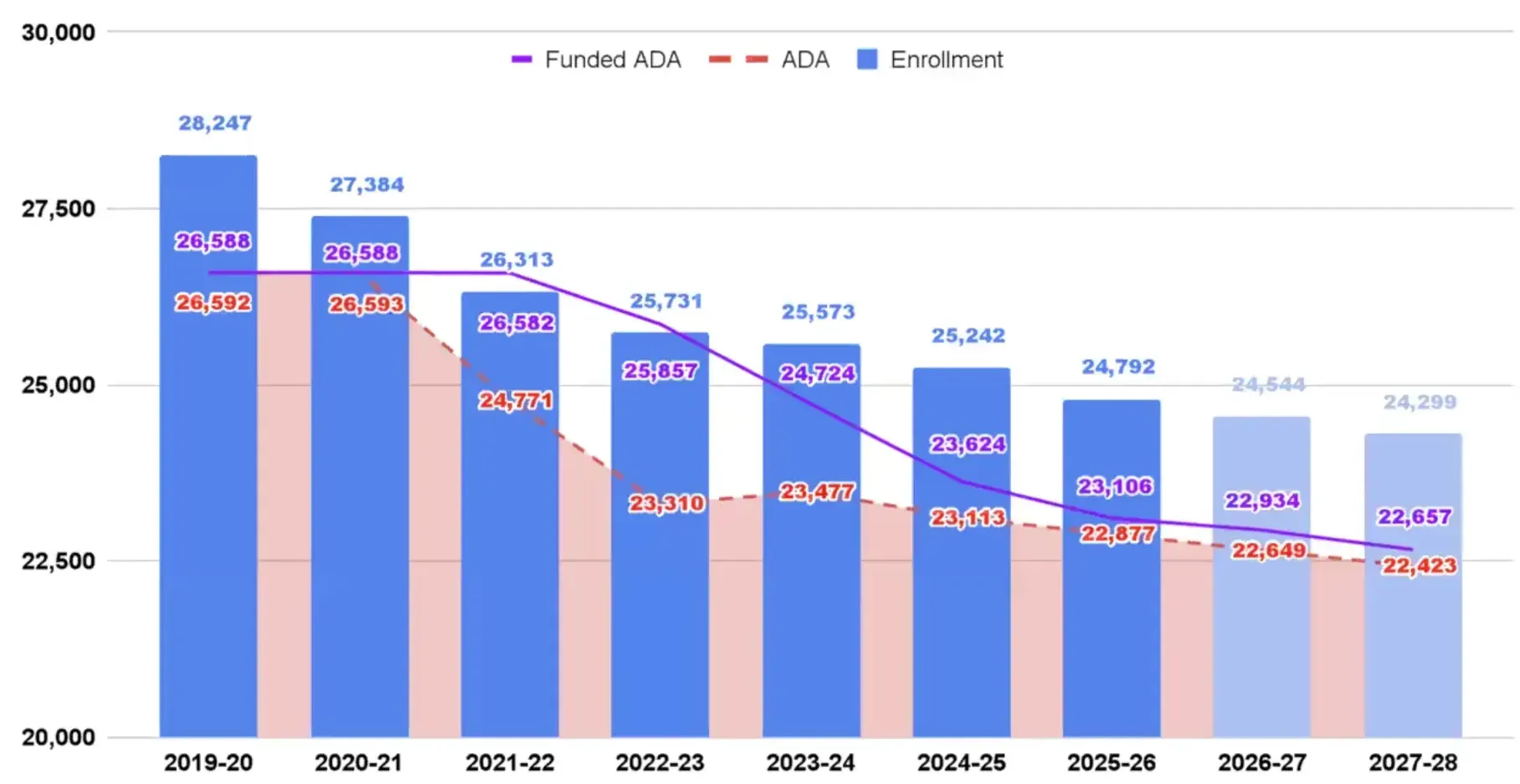
The deficit stems from multiple factors, including declining enrollment and a structural budget imbalance that existed before the strike. District enrollment has dropped from 28,247 students in 2019-20 to a projected 24,792 students this year, according to district data presented at the meeting.
“We’re looking at the difference between the students that we project to be here, the students that are actually here, and then how we’re funded to support those students,” Cotton told community members.
WCCUSD enrollment trends
Acting Associate Superintendent of Business Services Jeff Carter said the tentative agreements will cost $25.7 million, $39 million, and $41 million over the next three years across all unions for salary increases, health benefits and other negotiated items. Combined with the district’s existing operating deficit, the total reaches $127 million.
To address the shortfall, the district plans to exhaust $28.5 million from its reserve funds, with $23.5 million drawn this year and $5 million next year. Officials also plan to borrow $13 million from the district’s retiree health benefits fund.
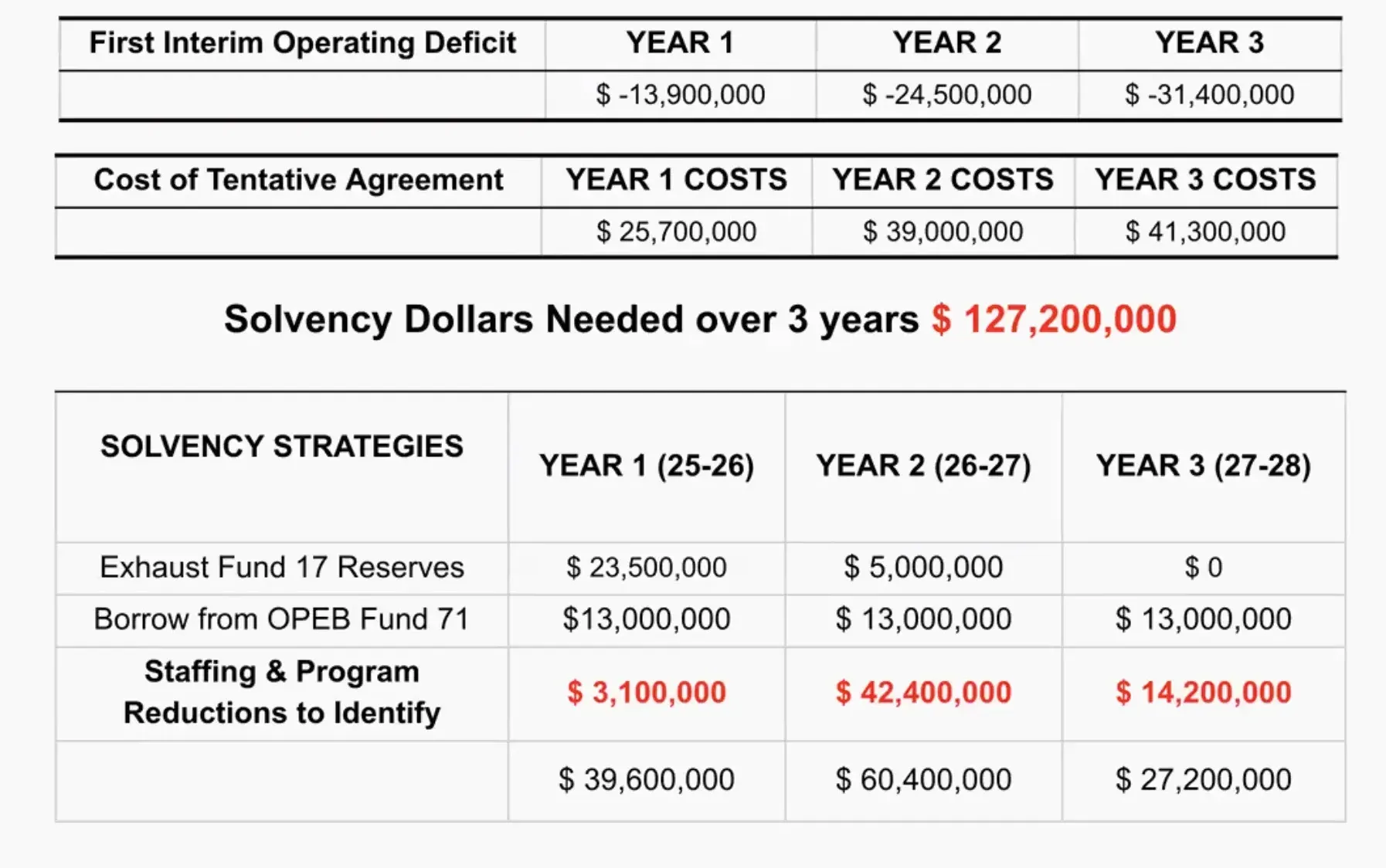
The remaining gap will require $42.4 million in staffing and program reductions for the 2026-27 school year, which must be identified now to meet California’s March 15 deadline for notifying employees of layoffs.
District officials propose approximately 10 percent cuts across all employee groups, reducing the workforce from about 4,000 to roughly 3,600. For teachers, the reduction would be slightly less than 10 percent, with officials hoping to achieve most cuts through attrition, including retirements and resignations.
Associate Superintendent of Teaching and Learning Katherine Acosta-Verprauskus presented the redesign proposals, describing them as difficult trade-offs made after careful consideration of impact, alignment, and sustainability.
“We are in a place where decisions have to be made,” Acosta-Verprauskus said. “We’re not going to be presenting abstract numbers now. We’re going to be presenting and representing difficult trade-offs that need to be made in a system that we all care very deeply about.”
The proposed cost-saving measures include a 33 percent reduction in materials and supplies totaling $2.4 million, cuts to district-wide contracts while maintaining site-level contracts that principals determine with staff and parent advisory committees, and “right-sizing” of classroom staffing to match contractual maximums of 22 students in kindergarten through third grade and 30 students in fourth through sixth grade.
At the secondary level, class sizes would increase to the contractual maximum of 35 students, representing $5.3 million in reductions. Schools are being asked to send out student choice sheets earlier to prioritize highly preferred courses and avoid opening sections with low student interest, Acosta-Verprauskus said.
The district also proposes $3 million in elementary classified staff reductions and $1.1 million at the secondary level, along with $2 million in district-wide program cuts based on their alignment to district priorities and impact on student achievement.
The district is also considering restructuring some K-8 schools and merging small middle schools with enrollment under 400 students.
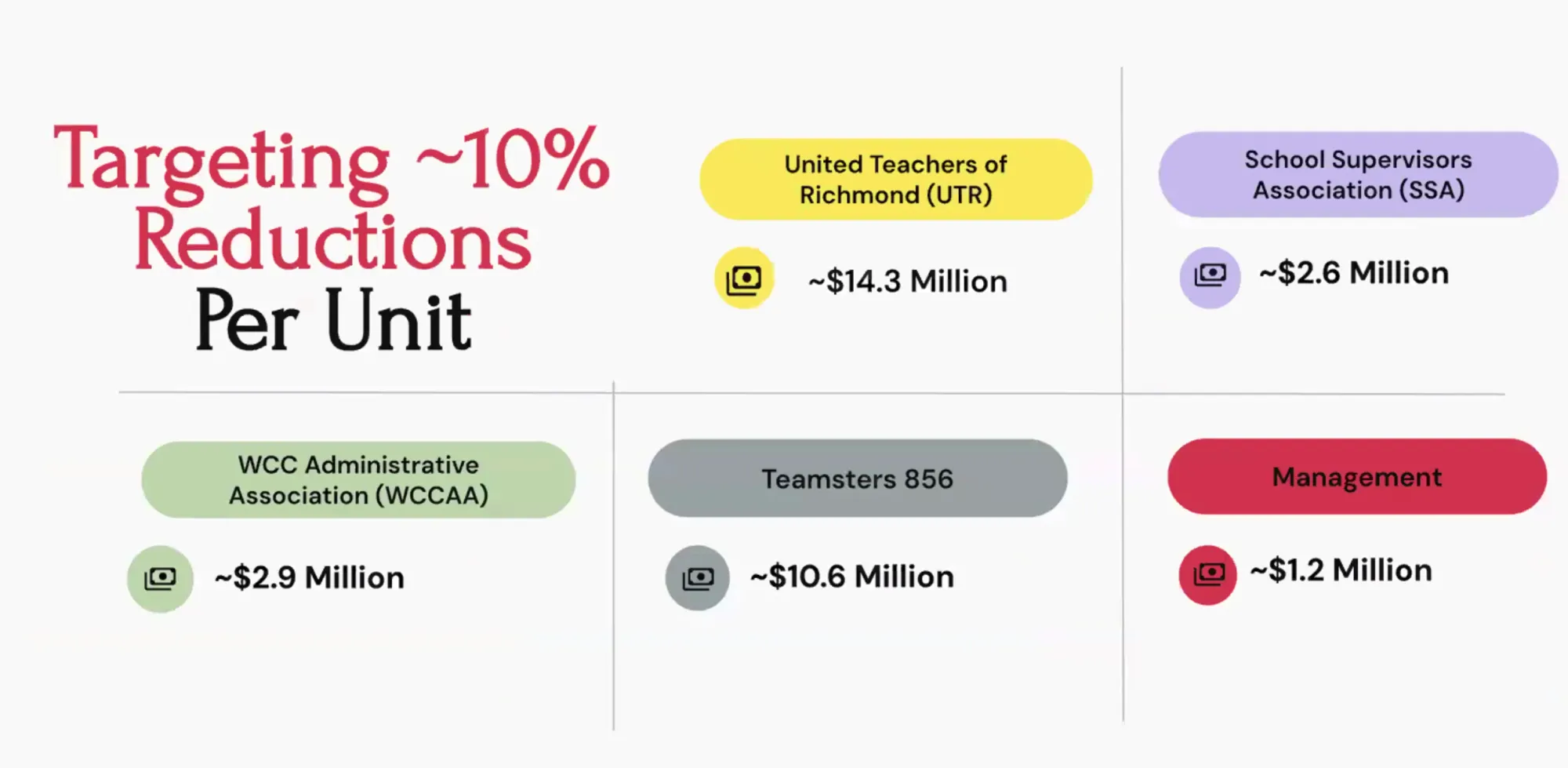
“Every single one of the tiles up there represents both people and programs, and you know, many of them are very beloved, but they are carefully being brought to you forward because they represent our current reality,” Acosta-Verprauskus said.
The district currently holds qualified budget status, indicating potential financial difficulties within three years. Cotton said the district submitted the required AB 1200 disclosure forms to the Contra Costa County Office of Education for review. The AB 1200 form, created after the district became the first in California to go into state receivership in 1991, requires the superintendent and chief business official to attest that the district can meet its financial obligations.
The school board is scheduled to vote on ratifying the union contracts on January 21.
By February 25, the board must vote on any staff reductions to meet the March 15 notification deadline. The board also requested an equity impact report for the February 11 meeting, explaining the rationale for the reductions and their effect on students and programs.
The district is collecting community feedback through online forms and additional listening sessions scheduled this month before the board makes its final decisions.
YOU GET MORE WITH A PAID SUBSCRIPTION
Your subscription enables Grandview Independent to deliver more:
- More time devoted to in-depth reporting
- Longer, more comprehensive stories
- Greater coverage of what matters to our community
Quality journalism costs money. Subscriptions allow us to keep reporting the stories that matter, without paywalls getting in the way of critical community information.
CLICK HERE TO SUBSCRIBE - Starting at just $10/month
FOLLOW US FOR BREAKING NEWS:
• Twitter: @GrandviewIndy
• Instagram: @GrandviewIndependent
• Facebook: @Grandview Independent
Copyright © 2025 Grandview Independent, all rights reserved.
Members Discussion