
Election'26
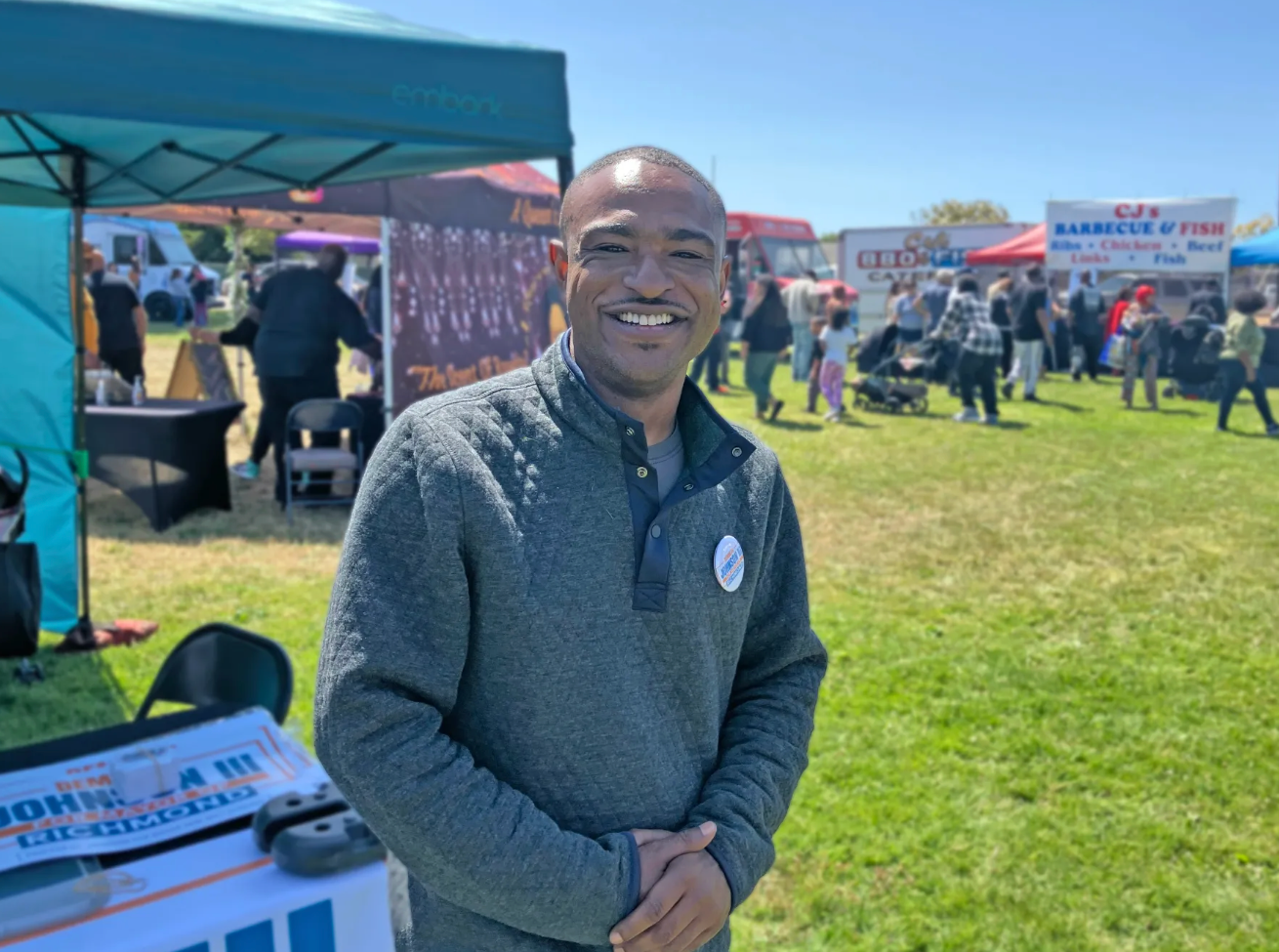
Demnlus Johnson is a fourth-generation Richmond resident. He grew up in the Iron Triangle, went to Howard University in Washington, D.C., and came straight back. He has never seriously considered leaving.
“I didn’t stay in D.C., I didn’t move to another city,” Johnson said. “I moved right back to Richmond. I’m a Richmond guy through and through.”
Johnson served on the City Council from 2018 to 2022 as an at-large representative. He holds a master’s degree in public policy from UC Berkeley’s Goldman School of Public Policy.
“Richmond deserves someone who’s always thinking about it,” he said. “I’m not looking to come in at the 12th hour and try to hold on to power.”
The council years
Johnson describes his time on the council as formative and sometimes contentious. He served as vice mayor and says there were periods when he stepped in as acting mayor. He also says he drew criticism from multiple factions for refusing to align himself with either side.
“I was raised in the city of Richmond when gang wars and turf killing were at an all-time high. I did not allow the street gangs to recruit me,” he said. “I’m not going to allow the political gangs to recruit me now.”
His approach, he says, earned him rebuke from both the Richmond Progressive Alliance and from then-Mayor Tom Butt.
He describes giving Councilmember Claudia Jiménez her first committee assignment as an example of how he approaches political disagreement. When Jiménez first joined the council, Johnson says Tom Butt gave her no committee assignments. He says even members of her own organization did not step up to help her get one.
“Not even people from her own organization gave her,” he said. “I gave her an assignment.”
Johnson says he horse-traded with Jiménez so she would have the CPRC, the Community Police Review Commission, because he felt she had been sent to the council by voters who expected her to have a real voice, and that cutting her out would betray that.
“She was voted in by a constituency who wanted her to have a voice, so to stifle that voice, to say that your voice doesn’t matter because of who you were elected by or which group brought you in, that’s not my style of leadership,” he said.
When the city transitioned to district-based representation, Johnson chose not to run for a district seat. His at-large position, which he said better matched how he understood Richmond as a whole city rather than a single neighborhood, was phased out at the end of his term. He subsequently made an unsuccessful bid for Congressional District 8 before turning his attention to the mayor’s office.
On public safety
In June 2020, the Richmond City Council voted to create the Reimagining Public Safety Community Task Force, a 21-member body drawn from the community, advocacy organizations, and law enforcement, charged with examining how the city spent its public safety dollars and whether resources should be redirected toward community programs. Johnson says the effort has been misrepresented, including, he implied, by people who were not involved in its creation at the council level.
“I know others walk around as if they were the ones who created Reimagine Richmond,” he said. “Reimagine Richmond was created by two Black male councilmembers: myself and Jael Myrick.”
The program, he said, grew out of a response to a proposal by Tom Butt to cut the police department’s budget by 50 percent. Johnson and Myrick wanted to create a genuine forum, involving the community, police, and public safety stakeholders, to have an honest conversation about how to allocate resources responsibly, not to defund police outright.
Johnson says he personally sat down with the police department’s budget manager to review their budget line by line, and describes himself as the only councilmember at the time to do so.
“The purpose, when Tom Butt had proposed that we cut the police department’s budget by 50 percent, me and Jael were like, let’s have a real conversation,” he said. “Because even if we do that, where’s that money going to go?”
What the program became, he said, was something different from what he and Myrick intended. He compared the rollout to a metaphor he returned to more than once: “You can have a steak, but if you present it on a garbage can lid, nobody’s going to want to eat the steak.”
The broader frustration he expressed was with a governing style he says has defined recent years in Richmond, one where decisions are made for the community rather than with it, and dissenters are treated as enemies.
“They brought this national divisiveness to the city of Richmond, when this whole time we’ve just been neighbors,” he said.
Johnson does not frame public safety as a choice between policing and social services. He says that framing is part of the problem.
“I’m not an either-or kind of person,” he said. “We can’t have a mayor who’s so gung ho on one side of the spectrum that they can’t see the holistic approach.”
He wants a fully staffed police department. He notes that violent crimes, including robberies and sexual assaults, rose even as homicide numbers improved, and says that when someone calls for help, officers need to answer and respond in a reasonable amount of time.
“When we say we want you focused on policing and not mental health, it’s not us coming down on you,” he said. “This is us trying to support you.”
He also points to his own upbringing to argue that you can’t separate community investment from public safety. Keeping community centers open, expanding youth jobs, funding after-school programs, and investing in mental health responders and the Office of Neighborhood Safety are, he says, what actually keep people from ending up in the system. In his view, those things aren’t alternatives to policing; they’re what make it work.
On housing
Johnson’s most pointed structural proposal is his call to eliminate the Design Review Board. He argues the city charter does not require the board, duplicates work already done by the Planning Commission, and has become a vehicle for cronyism and project delays.
“The DRB has been a consistent pain in the side of all projects,” he said. “It promotes cronyism and corruption. Most of the people on a design review board don’t know a damn thing about design or review.”
He says he has seen emails in which DRB members steered developers toward particular architecture firms in exchange for smoother proceedings, a reference to a controversy involving a development at 12th and Macdonald that he says has been circulating since he left the council without anyone acting on it.
“The fact that those emails have been floating around just about as long as I’ve been off the council, and nobody has done anything about it, lets me know that people are benefiting from this system of corruption,” he said.
His solution is to fold the DRB’s responsibilities into the Planning Commission and require that planning commissioners actually be qualified for the role, not appointed as a reward for campaign loyalty.
On economic development
Johnson wants to diversify the city’s revenue base away from its dependence on Chevron. He sees Richmond’s geography as an underused asset, accessible from Marin County, East Contra Costa, Solano County, and San Francisco via ferry, capable of drawing outside consumers into the city.
He envisions a tiered commercial landscape: mom-and-pop shops along corridors like 23rd Street and San Pablo Avenue, mid-size retail downtown, and destination-level retail at Hilltop capable of competing with Bay Street in Emeryville or downtown Walnut Creek.
But his bigger economic ambition is in manufacturing. He points to green empowerment zones in Richmond that he says are ready for battery pack production, solar panel assembly, and wind energy manufacturing, industries capable of paying $40 to $50 an hour in union wages.
“I’m thankful for Blue Apron and Amazon fulfillment centers,” he said. “But if we can get union jobs, skilled labor, where people can make 40 to $50 an hour, creating a green economy, that’s my goal.”
He ties the lack of large employers directly to a lack of leadership willing to actively recruit and to clear barriers for incoming businesses, noting that Richmond once led the county in manufacturing through the Kaiser Shipyards and a Ford Motor plant.
On governing
Johnson is quick to point out that he went to policy school, not law school or architecture school, and that the distinction matters. He says too many candidates running for mayor have not taken the time to study what the job actually requires, what powers it carries, and where the levers are. He calls himself a policy nerd and means it as a job description, not a boast.
“Folks don’t take the time to study the position that they’re actually going out for,” he said. “They don’t understand policy. I’m a policy nerd. I went to policy school.”
He argues that knowing the structure of Richmond’s government is not a minor detail. Richmond operates as a council-manager city, meaning the mayor holds a weak-mayor form of government. The core job, he says, is running effective meetings and making sound appointments, and he is struck by how many people in the race have not grasped that.
“You have to know what your job is. Bare bones, what is your job: running the meeting and appointments,” he said. “If you can’t run an effective meeting and make sound appointments, then what are we talking about?”
His priority would be sitting down with the city clerk to review policies and procedures for how council meetings are conducted, with an eye toward making them more efficient and ensuring city business gets handled first.
He also wants to bring a participatory budgeting model to Richmond, not public comment sessions at City Hall, but neighborhood budget meetings at community centers like Nevin, Shields Reid, and Booker T. Anderson, with finance department staff present and every city department required to report against measurable metrics.
“If you say you’re going to help a certain population of people and that thing is not being done, or you have not served yourself out of a job, then for me, it’s not working,” he said.
Beyond the resume
Johnson describes himself as a bibliophile who reads across genres, from young adult fiction to history, and says he dabbles in writing, including fan fiction and short screenplays. He has a television and film production background.
He is, by his own description, someone who takes Richmond personally. He says the city gave him everything he needed to survive and thrive, and that the mayoral campaign is his way of giving it back.
“There will be a day when I leave office, in eight years, when the Iron Triangle looks just as nice as Walnut Creek,” he said. “Not because of anything that I did, but because the people in that community had somebody to be a conduit.”
He is running as what he calls a big-tent candidate, not aligned with any faction, not interested in rewarding allies or punishing opponents, and prepared to work with whoever is on the dais after November.
Grandview Independent will publish interviews with all candidates running for Richmond City Council and mayor in the coming weeks.
YOU GET MORE WITH A PAID SUBSCRIPTION
Your subscription enables Grandview Independent to deliver more:
- More time devoted to in-depth reporting
- Longer, more comprehensive stories
- Greater coverage of what matters to our community
Quality journalism costs money. Subscriptions allow us to keep reporting the stories that matter, without paywalls getting in the way of critical community information.
CLICK HERE TO SUBSCRIBE - Starting at just $10/month
FOLLOW US FOR BREAKING NEWS:
• Twitter: @GrandviewIndy
• Instagram: @GrandviewIndependent
• Facebook: @Grandview Independent
Copyright © 2026 Grandview Independent, all rights reserved.
Members Discussion